50
Four hours in the kitchen


00:00
00:00

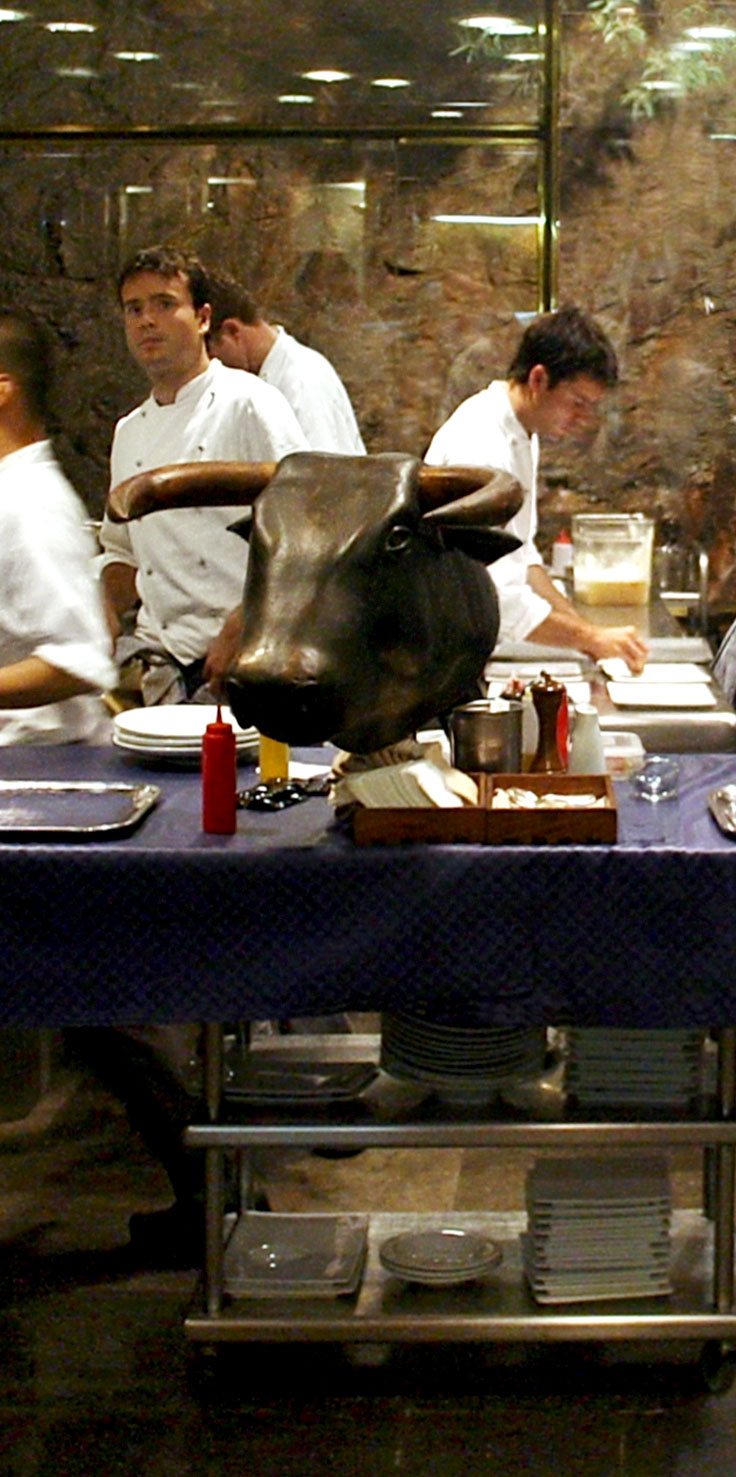
The kitchen and service departments are responsible for performing the thousands of tasks grouped into processes that take place every day in a restaurant.
Although most restaurants would have two different organisational cultures, what characterised elBullirestaurante’s organisational culture was its way of working together.
In order to consolidate this principle, joint meetings were held every day to plan the coordination of work. There was full awareness that, for the restaurant’s gastronomic offering to go exactly to plan, there was a need for total harmony between the kitchen and dining room.
The kitchen and front-of-house operated like an orchestra, like clockwork.
During the service of a tasting menu, with more than 40 elaborations per person – some of which would be individually adapted for diners with allergies or dietary restrictions – nothing could go wrong; there was no margin for error.
This required strict levels of coordination and discipline.
In the kitchen, the structure of responsibilities was measured to the millimetre so that everything would operate perfectly. The various tasks assigned to different individuals were intertwined so that the elaborations could be completed at the exact moment they had to be taken to the dining room, with a pace of service that was appropriate to each table.
The waiting staff not only had to be perfectly familiar with the elaborations they were serving, but they were often also responsible with finishing those elaborations at the table. Their participation in the elaboration of dishes required greater involvement as well as knowledge.
At the same time, the kitchen team was always ready to support the front-of-house team wherever required, either by transferring the elaborations or finishing them, turning cooks into waiters and offering a dynamic that further enhanced the dining experience.
elBullirestaurante always advocated an organisational culture for its reproduction system characterised by mutual understanding and coordination between the dining room and kitchen.
Both had to feel, and did feel, they were part of the same team.
Although most restaurants would have two different organisational cultures, what characterised elBullirestaurante’s organisational culture was its way of working together.
In order to consolidate this principle, joint meetings were held every day to plan the coordination of work. There was full awareness that, for the restaurant’s gastronomic offering to go exactly to plan, there was a need for total harmony between the kitchen and dining room.
The kitchen and front-of-house operated like an orchestra, like clockwork.
During the service of a tasting menu, with more than 40 elaborations per person – some of which would be individually adapted for diners with allergies or dietary restrictions – nothing could go wrong; there was no margin for error.
This required strict levels of coordination and discipline.
In the kitchen, the structure of responsibilities was measured to the millimetre so that everything would operate perfectly. The various tasks assigned to different individuals were intertwined so that the elaborations could be completed at the exact moment they had to be taken to the dining room, with a pace of service that was appropriate to each table.
The waiting staff not only had to be perfectly familiar with the elaborations they were serving, but they were often also responsible with finishing those elaborations at the table. Their participation in the elaboration of dishes required greater involvement as well as knowledge.
At the same time, the kitchen team was always ready to support the front-of-house team wherever required, either by transferring the elaborations or finishing them, turning cooks into waiters and offering a dynamic that further enhanced the dining experience.
elBullirestaurante always advocated an organisational culture for its reproduction system characterised by mutual understanding and coordination between the dining room and kitchen.
Both had to feel, and did feel, they were part of the same team.
Did you know…
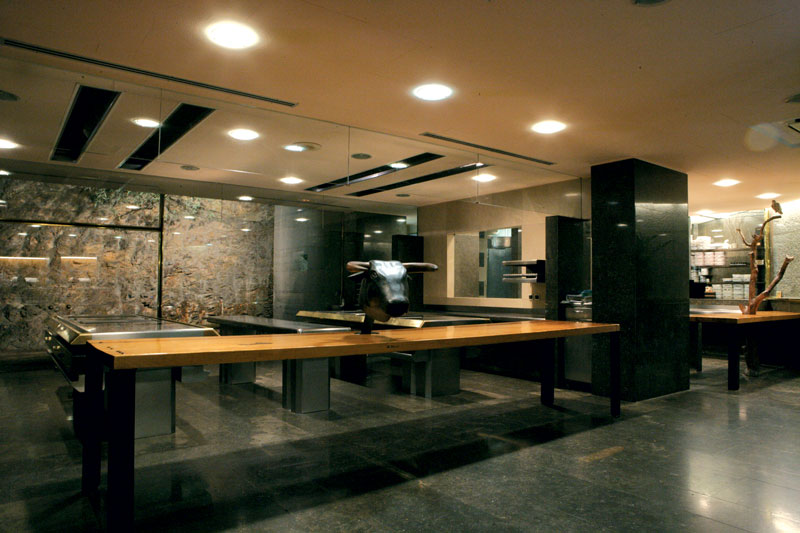
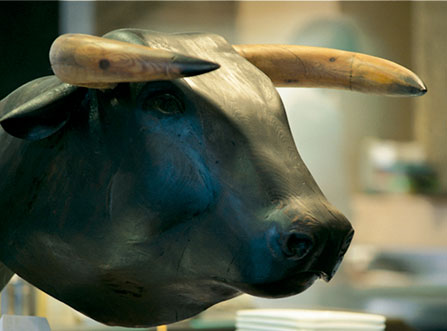
The famous bull that graced the serving bench was a gift from the artist Xavier Medina Campeny.
History of elBullirestaurante
1993 – The new kitchen
1993 – The new kitchen
After the work on the car park and terrace, one of the decisions made when elBulli became a limited company was to build a new kitchen. Ferran Adrià and Juli Soler visited the most modern kitchens in Europe, such as the one belonging to the Troisgros brothers in Roanne, which at that time was a benchmark.
In 1992, they already had a clear idea of which features to include, and so began an exciting process during which they planned and designed their dream space, with the collaboration of architect Dolors Andreu and Maquinarias García.
Models were made, and they decided to incorporate innovative materials not commonly used in kitchens – as well as sculptures by Xavier Medina Campeny, which soon became a symbol of the historic kitchen.
The result was a 325 square-metre space, with all the necessary facilities to enable the team to work in a completely new way, and in the most pleasant conditions possible. Without this kitchen, elBulli as we know it today would not have been the same and we can categorically state that it played an essential part in its evolution.

