00:00
00:00

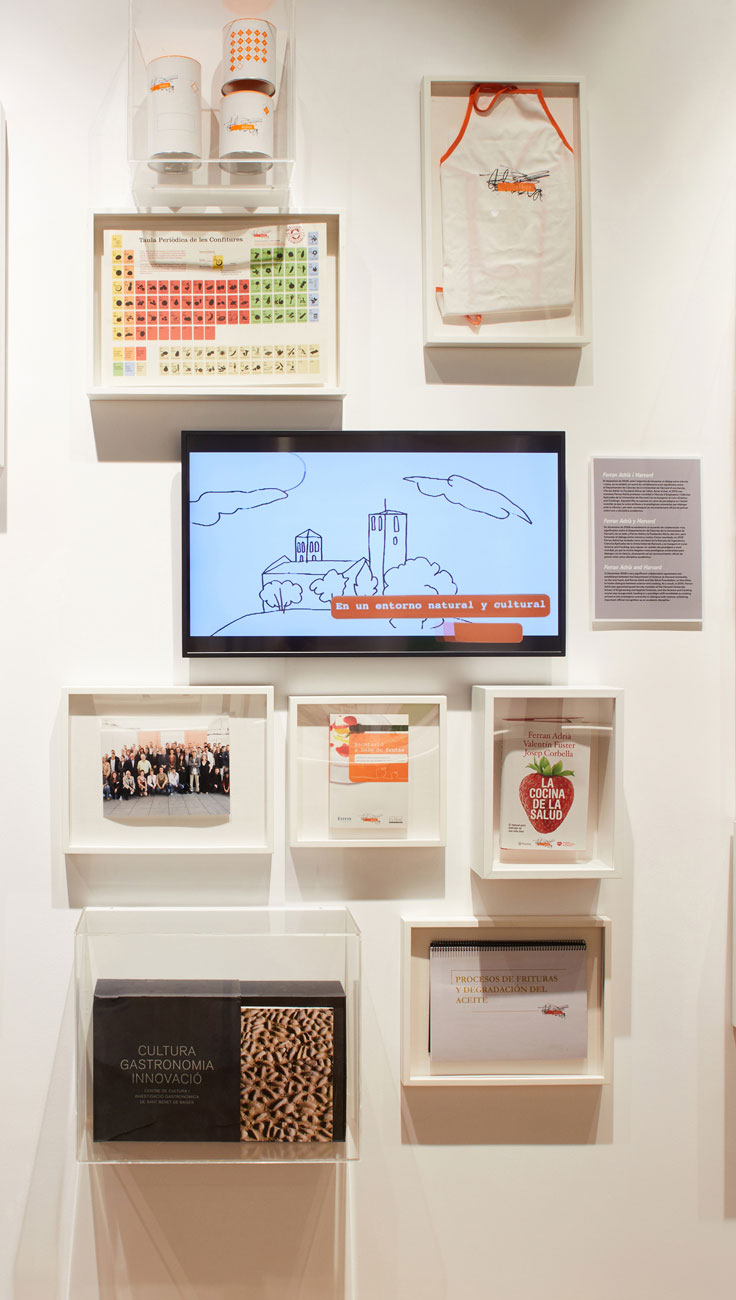
It brought cooking into the further education system as a major academic discipline, which has led to its inclusion in social projects that were previously approached exclusively from a scientific perspective.
Although Ferran Adrià’s interest in science began in 1996, when he attended a conference on physics and chemistry given by Hervé This at the Escoffier Foundation in Biarritz, he never attributed a scientific origin to his creations at elBulli, which were the result of a purely culinary quest.
The dialogue between chefs and scientists came about through a collaboration between elBulli and Pere Castells, a scientist and gastronome, and Ingrid Farré, a food technologist. Credit also lies in the gradual systematisation of the creative process with the establishment of the ephemeral scientific department at elBullitaller in 2003, which took on a role that would later be carried out by the Alícia Foundation, after it was set up the following year.
Castells explained the established procedures, developed systems for conducting culinary experiments and helped to refine the structure of the creative workshop. This new approach was also the impetus for the elBulli team to start compiling information from external sources by establishing contacts with manufacturers of new equipment and food products.
Consequently, the partnership between science and cooking led to what is known as molecular gastronomy, which, in elBulli’s case, spurred creativity by incorporating scientific knowledge in haute cuisine to create new paths in cooking.
However, we should note that all cooking is molecular by definition, given that it involves altering the molecular structure of substances by the application of heat or cold.
What changed in this case was that a dialogue was established between chefs and scientists, leading to the application of a gastronomic approach with the aim of developing new products, techniques and tools for cooking. This resulted in new elaborations and new culinary concepts.
In this context, a series of initiatives and procedures were established at elBullirestaurante to encourage this dialogue:
-
Use of a common, easily understood language. Like all disciplines, science uses a particular language, which may be considered highly technical and difficult to understand. It was, therefore, necessary to develop a new common language that would mutually benefit both fields of knowledge. For this purpose, elBulli developed a scientific and gastronomic lexicon as a tool designed to bridge both worlds.
-
The structuring of knowledge for the purpose of creating the foundations for the gastronomic and scientific dialogue; applying the scientific method characterised by rigour and objectivity when experimenting and recording results in the kitchen.
-
Having specialists from different disciplines within the field of science. Depending on the project, different types of scientific knowledge might be required, including physicists, chemists, food technologists and industrial engineers.
-
Disseminating all the research conducted internally. An essential and characteristic feature of the elBulli philosophy was sharing knowledge obtained from internal research to pave the way for other cooks and scientists to follow and provide feedback.
Ferran Adrià has travelled to the United States to negotiate two collaboration agreements with the prestigious Harvard University, perhaps the world’s best. Under the title ‘Dialogues between Science and Cooking,’ these commitments will partner the university with elBulli, creating an opportunity for cooperation between the institution in Cambridge (Massachusetts) and the Alícia (‘Food and Science’) Foundation, an institution founded by the chef and cardiologist Valentí Fuster and led by Toni Massanés. The aim of this cooperation is to discover possible applications for the creativity in haute cuisine that can lead to solutions for social problems. It is also a mutually beneficial one in that it will also provide gastronomic solutions to be implemented in the world of cooking to make chefs’ work easier.
As of January, members from Alícia will travel to Massachusetts, and a person from Harvard University will travel to Catalonia to become acquainted with elBulli. There is also the idea of publishing a book and creating a course of cooking and science which, in Ferran Adrià’s words, ‘will become a benchmark for both scientists and cooks, and any other person interested’ in these subjects.
Adrià believes in seeing food as a language that allows ‘impressions, feelings, sensations and experiences to be conveyed’. ‘Cooking is a language with its own alphabet,’ he added. ‘Starting with an alphabet, each cook creates their own conversation. Our role as chefs is to broaden this dialogue, which offers the world new forms of culinary expression.’ ‘Five years ago, something like this would have been unthinkable. I believe it gives great credibility to what is happening in Spanish cuisine in terms of creativity and research,’ declared Adrià proudly, reminding us that ‘in research, resources are limited’. ‘Helping out is the future,’ he concluded.
In particular, study will involve the use of hydrocolloids (‘gums’ that allow a delicate fruit purée to be turned into a thick jelly), the deconstruction of techniques such as spherification and the creation of a skin resistant to liquids.
His lecture, sponsored by the Harvard Materials Research Science and Engineering Center, as well as the Nanoscale Science and Engineering Center, and promoted by the Harvard Physics Department and the School of Engineering and Applied Sciences, is part of a three-day visit to the university. In addition to meeting professors of physics and engineering, Adrià will also be a guest lecturer for the Innovation in Science and Engineering course, and he will be at the Harvard Business School Campus discussing how to achieve success in managing restaurants.
2010–present
In December 2010, Ferran Adrià presented the first edition of the course Science & Cooking: From Haute Cuisine to Soft Matter Science, jointly organised by Harvard University and the Alícia Foundation.
This is a project designed as a forward-looking platform for elBullifoundation. It was a real paradigm shift, being it was the first time that cooking entered high-level university classes to interact with science. Download the video here