59
Richard Hamilton & elBulli: a magical relationship


00:00
00:00

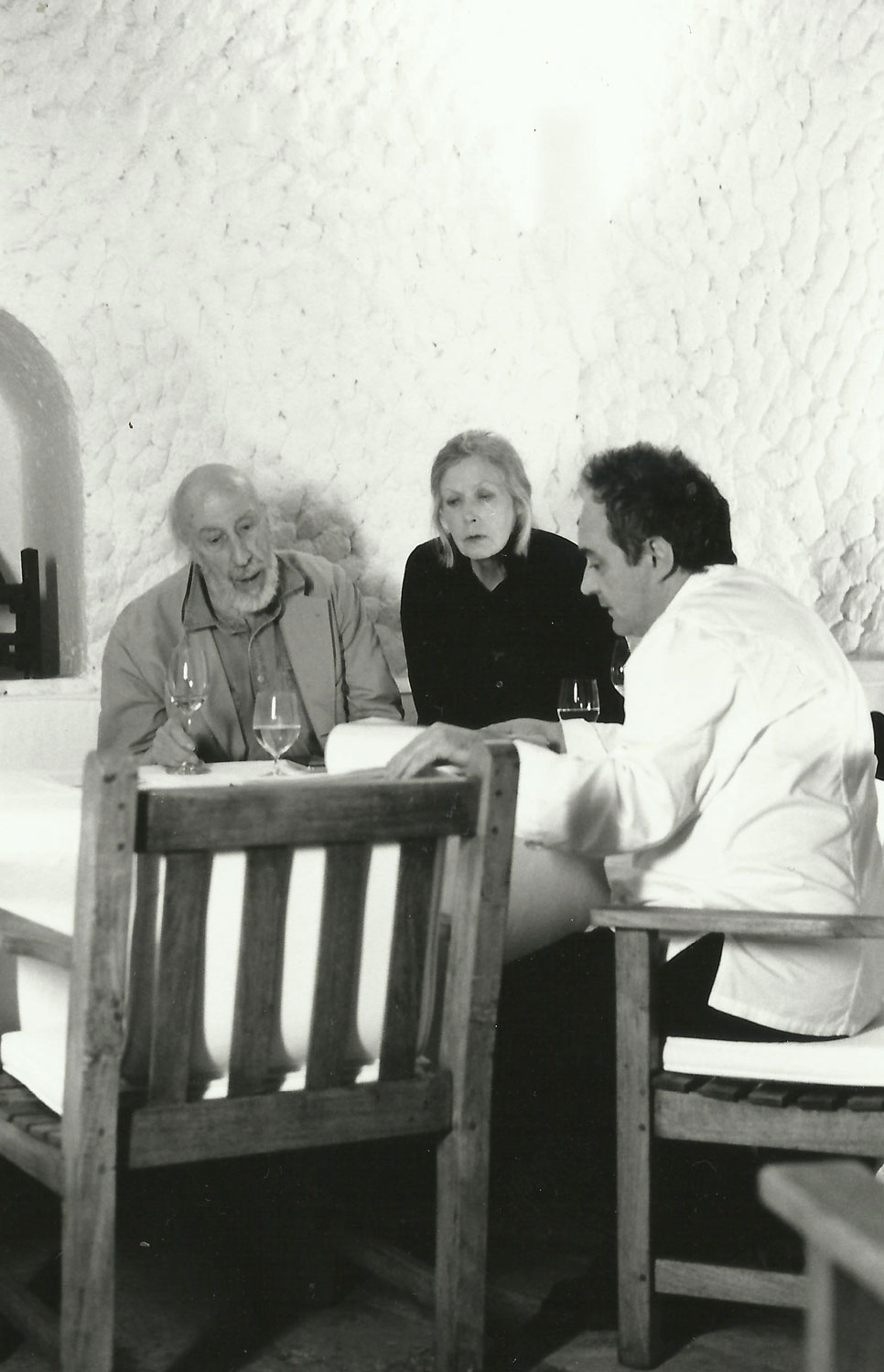
A longest-standing friendship with Richard Hamilton, who was also one of the most influential customers in the restaurant's history, has provided an insight into the meaning and impact of elBulli’s work.
The artist’s relationship with elBulli dates back to 1963, when Marcel Duchamp told him about a restaurant to be found a short boat ride from Cadaqués, a place where he spent long sojourns.
From that moment on, table 20 on the restaurant’s terrace was the setting for many magical moments shared by Richard and Rita, his wife, with Ferran, Juli and the team. These moments filled with mutual admiration have resulted in wonderful exchanges and collaborations.
This close friendship and mutual understanding has created a legacy of great intellectual, artistic and emotional value for elBullirestaurante’s history.
The artist’s relationship with elBulli dates back to 1963, when Marcel Duchamp told him about a restaurant to be found a short boat ride from Cadaqués, a place where he spent long sojourns.
From that moment on, table 20 on the restaurant’s terrace was the setting for many magical moments shared by Richard and Rita, his wife, with Ferran, Juli and the team. These moments filled with mutual admiration have resulted in wonderful exchanges and collaborations.
This close friendship and mutual understanding has created a legacy of great intellectual, artistic and emotional value for elBullirestaurante’s history.
Richard Hamilton
(London, 1922–2011)
The British artist Richard Hamilton was a pioneer of pop art and one of the most important painters in the history of 20th-century art.
He studied at the Royal Academy of Arts and Slade School of Fine Art, and later went to teach at King’s College, now the University of Newcastle.
During the 1950s, he staged the exhibitions Growth and Form and Man, Machine & Motion at the Institute of Contemporary Arts in London. In 1956, he took part in the This is Tomorrow exhibition in London, for which he created his collage Just what is it that makes today’s homes so different, so appealing?
Throughout his career, Hamilton exhibited all over the world and was the subject of major retrospective exhibitions at the Tate Gallery, London, in 1970 and 1992, the Solomon R. Guggenheim Museum, New York, in 1973, the Nationalgalerie, Berlin, in 1974, and MACBA, Barcelona, and the Museum Ludwig, Cologne, in 2003.
His first solo exhibition was at London’s Hanover Gallery in 1955. It was followed by others at the Stedelijk Museum, Amsterdam, in 1976; the Kunsthalle Bielefeld, in 1978 and 2008; the Fruitmarket Gallery, Edinburgh, in 1988; the Moderna Museet, Stockholm, in 1989; the Kunst Museum Winterthur, in 1990 and 2002; the San Francisco Museum of Modern Art, in 1996; the British Museum, London, in 2002; and the Palazzetto Tito during the Venice Biennale in 2006 with the exhibition A Host of Angels.
Hamilton took part in other exhibitions, such as documenta 4 in Kassel, in 1968; the São Paulo Art Biennial in 1989; documenta 10 in Kassel, in 1997; and the Shanghai Biennale in 2006.
Included among the many awards and acknowledgements he received were the John Moores Painting Prize of 1969; the Talens Prize International of 1970, the Leone d’Oro at the Venice Biennale of 1993 for his exhibit in the British Pavilion; the Arnold Bode Prize at documenta 10, Kassel, in 1997; and the Max Beckmann Prize for Painting in 2006. In 1999 he was made a Member of the Order of the Companions of Honour, and he was awarded the Praemium Imperiale prize for painting in 2008.
The British artist Richard Hamilton was a pioneer of pop art and one of the most important painters in the history of 20th-century art.
He studied at the Royal Academy of Arts and Slade School of Fine Art, and later went to teach at King’s College, now the University of Newcastle.
During the 1950s, he staged the exhibitions Growth and Form and Man, Machine & Motion at the Institute of Contemporary Arts in London. In 1956, he took part in the This is Tomorrow exhibition in London, for which he created his collage Just what is it that makes today’s homes so different, so appealing?
Throughout his career, Hamilton exhibited all over the world and was the subject of major retrospective exhibitions at the Tate Gallery, London, in 1970 and 1992, the Solomon R. Guggenheim Museum, New York, in 1973, the Nationalgalerie, Berlin, in 1974, and MACBA, Barcelona, and the Museum Ludwig, Cologne, in 2003.
His first solo exhibition was at London’s Hanover Gallery in 1955. It was followed by others at the Stedelijk Museum, Amsterdam, in 1976; the Kunsthalle Bielefeld, in 1978 and 2008; the Fruitmarket Gallery, Edinburgh, in 1988; the Moderna Museet, Stockholm, in 1989; the Kunst Museum Winterthur, in 1990 and 2002; the San Francisco Museum of Modern Art, in 1996; the British Museum, London, in 2002; and the Palazzetto Tito during the Venice Biennale in 2006 with the exhibition A Host of Angels.
Hamilton took part in other exhibitions, such as documenta 4 in Kassel, in 1968; the São Paulo Art Biennial in 1989; documenta 10 in Kassel, in 1997; and the Shanghai Biennale in 2006.
Included among the many awards and acknowledgements he received were the John Moores Painting Prize of 1969; the Talens Prize International of 1970, the Leone d’Oro at the Venice Biennale of 1993 for his exhibit in the British Pavilion; the Arnold Bode Prize at documenta 10, Kassel, in 1997; and the Max Beckmann Prize for Painting in 2006. In 1999 he was made a Member of the Order of the Companions of Honour, and he was awarded the Praemium Imperiale prize for painting in 2008.
Exhibited works
Balzac unknown masterpiece
Creative process for the posthumous exhibition ‘Richard Hamilton: The Late Works’,The National Gallery, London.
10 October 2012–13 January 2013
This highly personal exhibition of the works of one of Britain’s most influential artists traces an intriguing path leading to his unfinished and unseen final work, Le Chef-d’oeuvre inconnu—a painting in three parts.
Up until his death at the age of 89, Richard Hamilton had been planning this major exhibition of recent works specifically conceived for the National Gallery and including work never before seen by the public. The exhibition in its entirety encapsulates many of the significant directions Hamilton’s art had taken over recent decades, when his international reputation took off.
Just before his death, Hamilton was at work on a major painting based on Honoré de Balzac’s short story Le Chef-d’œuvre inconnu (The Unknown Masterpiece). When it became clear he would not live to finish the work, Hamilton decided that the National Gallery exhibition – the first significant one since his death – would culminate in the presentation of the large-scale variations on this work, using computer-generated images painted over by hand.
Preliminary drawing by Richard Hamilton for his interpretation of Las Meninas by Velázquez
A preliminary drawing that formed part of the creative process leading up to the print made by Hamilton in 1973 for the portfolio Hommage à Picasso (Tribute to Picasso), issued to mark the Spanish artist’s 90th birthday.
The series that was exhibited at the Museo del Prado in 2010 comprised five preliminary and preparatory drawing and six proofs that culminate in the definitive print, a tribute by Hamilton to Picasso through the reinterpretation of his reinterpretation of Velázquez’s masterpiece.
Richard Hamilton
Self-portrait.
Polaroid Portrait of Richard Hamilton
By Ferran Adrià.
Ferran Adrià’s chef jacket with dedication by Richard Hamilton
‘All the world’s a stage, with Montjoi its greatest theatre.’
Richard Hamilton
Personal note
Email accompanied by a heart-felt illustration in which Richard Hamilton and Rita Donagh communicated they could not possibly attend the ‘Last Waltz’ at elBulli on 30 July 2011.
Dear friends,
You can’t imagine how Rita and I regret not being at elBulli tonight. It is a great honour to know that we would have been welcomed by so many friends on the terrace at Montjoi where we’ve spent the happiest hours of our life. Now fate has dropped shit on our plans, what a bastard.
Rita and Richard
Reflection on the influence of Ferran Adrià’s work, comparing it with the first photograph ever taken in 1823
Roland Barthes’ great little book Camera Lucida includes a remarkable photograph by the French scientist and inventor Joseph Niepce with the inscription ‘The first photograph’. It competes for the honour of precedence with another Niepce image titled ‘View from the window’, taken from his family’s country home. I like to think that they share the same date, 1823.When the genius that is Ferran Adrià was first acclaimed, he said: ‘I may not be the greatest chef in the world, but I have contributed more inventions than any other.’ Niepce’s simple table set for lunch two centuries ago symbolises Adrià’s revolution.
RH
Creative process for the posthumous exhibition ‘Richard Hamilton: The Late Works’,The National Gallery, London.
10 October 2012–13 January 2013
This highly personal exhibition of the works of one of Britain’s most influential artists traces an intriguing path leading to his unfinished and unseen final work, Le Chef-d’oeuvre inconnu—a painting in three parts.
Up until his death at the age of 89, Richard Hamilton had been planning this major exhibition of recent works specifically conceived for the National Gallery and including work never before seen by the public. The exhibition in its entirety encapsulates many of the significant directions Hamilton’s art had taken over recent decades, when his international reputation took off.
Just before his death, Hamilton was at work on a major painting based on Honoré de Balzac’s short story Le Chef-d’œuvre inconnu (The Unknown Masterpiece). When it became clear he would not live to finish the work, Hamilton decided that the National Gallery exhibition – the first significant one since his death – would culminate in the presentation of the large-scale variations on this work, using computer-generated images painted over by hand.
Preliminary drawing by Richard Hamilton for his interpretation of Las Meninas by Velázquez
A preliminary drawing that formed part of the creative process leading up to the print made by Hamilton in 1973 for the portfolio Hommage à Picasso (Tribute to Picasso), issued to mark the Spanish artist’s 90th birthday.
The series that was exhibited at the Museo del Prado in 2010 comprised five preliminary and preparatory drawing and six proofs that culminate in the definitive print, a tribute by Hamilton to Picasso through the reinterpretation of his reinterpretation of Velázquez’s masterpiece.
Richard Hamilton
Self-portrait.
Polaroid Portrait of Richard Hamilton
By Ferran Adrià.
Ferran Adrià’s chef jacket with dedication by Richard Hamilton
‘All the world’s a stage, with Montjoi its greatest theatre.’
Richard Hamilton
Personal note
Email accompanied by a heart-felt illustration in which Richard Hamilton and Rita Donagh communicated they could not possibly attend the ‘Last Waltz’ at elBulli on 30 July 2011.
Dear friends,
You can’t imagine how Rita and I regret not being at elBulli tonight. It is a great honour to know that we would have been welcomed by so many friends on the terrace at Montjoi where we’ve spent the happiest hours of our life. Now fate has dropped shit on our plans, what a bastard.
Rita and Richard
Reflection on the influence of Ferran Adrià’s work, comparing it with the first photograph ever taken in 1823
Roland Barthes’ great little book Camera Lucida includes a remarkable photograph by the French scientist and inventor Joseph Niepce with the inscription ‘The first photograph’. It competes for the honour of precedence with another Niepce image titled ‘View from the window’, taken from his family’s country home. I like to think that they share the same date, 1823.When the genius that is Ferran Adrià was first acclaimed, he said: ‘I may not be the greatest chef in the world, but I have contributed more inventions than any other.’ Niepce’s simple table set for lunch two centuries ago symbolises Adrià’s revolution.
RH

