How the process has been carried out
2011
How the process has been carried out
The foundation press release already mentioned that a project to make an encyclopaedia of Tecnoemocional Cuisine was under way.
2012
January
Ferran Adrià, Eduard Xatruch, Oriol Castro and Josep Maria Pinto are installed in elBullitaller.

January 31st
We decide to bring together all the culinary information generated by elBulli. The name Bullipedia is chosen for this project.
February 1st to 15th
We analyse the classification of culinary products and, in the end, decide that the pertinent questions are: What is cooking? / Why do we cook?
Initial proposals to draw up product datasheets are made.
February 20th
We produce a product datasheet for white asparagus. This is the first step towards an understanding of unelaborated products.
March 14th to 30th
We produce an index of elaborations.
April 1st to 15th
Development of the indexes is undertaken for all the category families that we consider should be included in Bullipedia.
First technological classification of devices and utensils, which we later denominate as tools.
April 19th to 30th
We draw up the indexes of styles and characteristics according to the criteria of the General Catalogue of elBullirestaurante.
May
We commence our dialogue with widely recognised experts, so as to benefit from their feedback on the project. These include Carlos Domingo, Dídac Ramírez, Israel Ruiz, Toni Segarra, Risto Mejide, Bonaventura Clotet, Jorge Wagensberg, Pau García Milà and Dídac Lee.
May 2nd
We initiate ideas4transformation, an international research challenge, organised in conjunction with Telefónica and directed at MBA students from the Harvard Business School, Haas School of Business at the University of California Berkeley, Columbia University, London Business School and Esade Business School. The aim of the challenge is to gather ideas for elBullifoundation.

June
In elBullitaller we make concept maps addressing the themes of innovation, creation, creativity, the history of cuisine, what cooking is, etc.
We reflect on the contents of books written about the history of haute cuisine.
July
Bullipedia comprises the following:
- elBulliToday – “Creativity today”
- An ideas drawer
- A Wiki of Haute Cuisine
July 20th
The organisational and philosophical indexes are drawn up, analysing how category families will be grouped.
August
As a result of our collaboration with Telefónica I+D Barcelona, the first design draft for Bullipedia is made for presentation at Wired, London.
We start work on a presentation video for the London event.
Analysis into Bullipedia’s business model is carried out.
August 28th
An inventory of work categories for investigation at Bullipedia is compiled.
August 27th to September 30th
Elaborations are re-analysed and placed in category families. Development is carried out to determine how they would be navigated on the web.
September
Analysis is made of the family of elements, such as crockery, glassware and cutlery, into which the final elaborations served to the diner are placed. Initially these elements are wrongly categorised as Technology.
October
Following evaluation, we come to an appreciation that elaborations are the result of techniques. This is the first step in the creation of a new map.
We come to the conclusion that food preservation is an intended outcome, and so it should be regarded as a separate entity in Bullipedia. The techniques of the culinary process are required for food preservation, but with a different end in mind.
We create a new concept that we name: “alaboraciones”.
New categories of culinary techniques (4 techniques previously existed) are conceived and their content is developed.
October 10th
Work begins on a general timeline of the history of cuisine.
October 15th
Work is started on a glossary of Bullipedia definitions.
October 22nd
The indexes of the 50 most important books in the history of cuisine are consulted and documented.
We make an index of Bullipedia’s classifications to date.
October 23rd
A collaboration agreement between elBullifoundation and UB (Universitat de Barcelona) is signed.
October 25th
The official presentation of Bullipedia takes place at Wired, London. It is an event of historic relevance for this new technologies sector. Ferran explains the function and content of “Creativity today” and the “Creative Archive”.
October 25th to 28th
The recipes of Auguste Escoffier are deconstructed to analyse their composition and formation in Le guide culinaire.
October 30th to 31st
We make the first classification index of dishes. This represents the final result of the culinary process.
November
Work starts on the administrative aspects of the Bullipedia website, the first step towards introducing content. This project was later postponed when we began to appreciate the complications of creating website content.
November 1st to 5th
A Bullipedia simulation of traditional Spanish cuisine is carried out.
November 6th to 8th
A joint collaboration with CETT (Barcelona School of Tourism, Hospitality and Gastronomy) is inaugurated.
Cooking techniques: further research into cooking without heat led to a modification of existing classifications of cooking techniques.
November 12th
Work commences on drawing up a comprehensive list of references (concentrating particularly on websites and blogs) to identify sources of information, and locate the sites with the most complete and detailed information.
November 13th
Documents are prepared posing the question: “What is cooking?”
Work undertaken since the previous summer had mapped this line of inquiry. Now its importance is realised and the concept of “DNA” is born.

November 21st
Drinks: initial classifications and index. Further work is pending. The same situation applies to decorations.
December
We come to understand that elaborated products are elaborations previously prepared for our use by others.
During the first week of December research of books and printed material shows us that final elaborations (consumed by the diner) are classified by:
- Main product.
- Uses.
- Organoleptic themes.
We reflect on the fact that an infinite number of products can be consumed, and that a book can only contain part of the possible products identified as such.
Rethinking and further development of the classification of products is undertaken. A visual classification of products is made, offering a new reflection on the classification of culinary products.
- In the classifications used in cooking there are different approaches:
- Uses: aromatic herbs, spices, vegetables, fruits, etc.
- Botanical families: algae, fungi, etc.
- This is a complicating factor when attempting to achieve a global understanding of the subject.
December 21st
Adapting elBulli’s model, we reset all previous work undertaken on Bullipedia and recommence our research.
2013
January
We move into elBullicarmen, where we undertake our first conceptualised work concerning the whys and wherefores of cuisine and gastronomy.
February 7th
We set up elBullifoundation, Fundació Privada.

March
We make card index templates for tools and culinary techniques.
March 18th
Official presentation of Bullipedia for press and chefs in the Aula Magna of UB (Universitat de Barcelona).

May
Periodic visits are made to CETT (Barcelona School of Tourism, Hospitality and Gastronomy) to work on product sheets. The conclusions reached following this collaborative work sees a modification of the product sheet template.
Agreement is reached with ESCAC (The Film and Audiovisual School of Catalonia) and filming commences on the work of Bullipedia.
May 14th
Presentation and delivery of the classification of products to the UB-Bullipedia Unit, at the Food and Nutrition Torribera Campus, Universitat de Barcelona.
May 23rd
Event, led by Jèssica Jaques, at Fundació Miró, discussing the creative process with the creative team of UAB (Universitat Autònoma de Barcelona).
June
David Casacuberta, professor of UAB (Universitat Autònoma de Barcelona), commences work on a product search engine, utilising different approaches.
All the documents relating to the DNA projects are brought together and renamed DNA.
Conceptual maps are made of products, techniques and elaborations, with the aim of incorporating them into a more easily understood lexicon.
We reflect on where culinary art began, examining the roles played by Carême and Escoffier.
We start working on the development of the Bullipedia “work in progress” website.
July
Analysis of the book De re cocquinaria by Apicius.
We prepare an updated list of the most important books in the history of cooking.
Discussions are held with digital culture expert Marco Bellonzi to understand how we can carry out computer searches on the content of individual books.
A meeting takes place between Ferran Adriá, CETT (Barcelona School of Tourism, Hospitality and Gastronomy) and the Minister of Culture, Irene Rigau, in which we propose that the collaboration between CETT and Bullipedia can bring student credits to those participating students.
Meeting at UB (Universitat de Barcelona) to help us classify the documentation that will be used in Bullipedia.
Based on the documentation available to us, we classify the entire history of Western culinary art into three major periods.
- Cooking theory: Palaeolithic and Neolithic periods. We rely on the research of archaeologists and anthropologists.
- Relative Theory of Cooking: encompassing the Ancient Civilisations and up to the year 1370. There are many studies from this period, but no direct culinary documentation.
- Reality of cooking: from Le Viandier (1370) onwards we regularly encounter books that can help us determine the nature of culinary art during every era.
A general document is written to outline the aims and objectives of Bullipedia.
We arrive at the conclusion that the graphic information we have created for different products (pictograms, etc) really constitute datasheets, and so decide on the name CuTesis to refer to this exhaustive work on diverse topics (products, techniques, elaborations, etc). CuTesis are “culinary theses” that relate to the world of cuisine.
We commence work with Bestiario on the design of the “Decoding” map.

August
Accommodation around the greater Barcelona area is sought in order to house the Bullipedia project. The possibility of moving Bullipedia to The Alícia Foundation (Food and Science) is considered.
All the information generated hitherto about Bullipedia is relocated to elBullicarmen, along with the library previously situated in elBullitaller.
September 9th / November
The HackingBullipedia challenge is launched, sponsored by Telefónica I+D Barcelona, researching and identifying the tools currently available on the Internet that can be employed by Bullipedia. The most prestigious technological universities from around the world participate in this research project.

2014
In early 2014 we contextualise concepts, such as the “creative process”, the “reproduction process” and the “experiential process”.
April 15th
BullipediaLAB opens: a 1,500 m2 workspace located at Calle Mèxic 17, Barcelona, that facilitates continued work on the Bullipedia project. The elBullifoundation team also relocates there to continue their work. The base team comprises Ferran Adrià, Eugeni De Diego, Rita Soler, David López, Ernest Laporte, Josep Maria Pinto and Lluís García.

April 22nd
BullipediaLAB welcomes its first student volunteer. The volunteer is from the Basque Culinary Center and joins the UB-Bullipedia Unit, based in the Food and Nutrition Torribera Campus.
May 6th
A framework collaboration agreement is established between Fundación Privada Elisava Escuela Universitaria and elBullifoundation. Its mission is to undertake a series of joint projects to promote and encourage the growth of a design and gastronomy culture.
May 30th
A collaboration agreement is signed between elBullifoundation and Mugaritz to write the history of cuisine.
July 28th
An agreement is reached between the Education Department of the Generalitat de Catalunya and elBullifoundation to undertake practical training in workplaces. This will lead to collaboration agreements with different academic institutions, facilitating the incorporation of students in elBulliLab in order to participate in the research projects that are being developed there.

September
Work begins on the Unelaborated Products project. All research work carried out from 2012-14 is classified, leading to its conceptualization as a distinct project.
October
Commencement of a project (that will become known as Sapiens) to create a methodology for classifying and understanding the gastronomic sector in the West. As further development of the methodology takes place, we begin to appreciate that the methodology is ideal for understanding a given field of study. Decoding systems and developments facilitate a historical analysis of the chosen field of study from a creative and evolutionary perspective.
A decision is made to utilise the new methodology to interpret all elBullifoundation projects.
October 15th
The Generalitat de Catalunya decides to include elBullifoundation in the Census of Volunteer Organisations of Catalonia. This means that volunteers from all around the world can participate in the foundation’s research projects.
The “Decoding the Design Process” project is undertaken in collaboration with the Elisava Barcelona School of Design and Engineering. This project involves classifying and decoding the processes involved in industrial design, and is carried out in accordance with the Sapiens methodology.
November 22nd
The Map of the Creative Process is presented at Harvard University.
During 2014
Oriol Castro, Eduard Xatruch and Mateu Casañas begin their own personal project, a restaurant called Disfrutar, and Eugeni De Diego becomes the director of Bullipedia.
2015
February
The methodological approach provisionally called Sapiens is now given that name officially.

March
Bullipedia is conceptualised as a multimedia project. The project we previously referred to as Bullipedia is now renamed Seaurching.

May
BullipediaLab is renamed as elBullilab.

June
Work commences on the project called “How cooking began”, both in paper and digital formats.
July
The creation of a lexicon of the 100 most used culinary products is proposed. This will be in digital format and is conceived of as a precursor to Seaurching.

Approximately seventy people now work at elBullilab, including chefs, designers, computer programmers, historians, archaeologists, artists, architects, interior designers, mathematicians, biologists, botanists, etc.


September
The “Unelaborated Product” project commences. It is envisaged that this will grow organically, giving rise to the potential for the publication of a book, an exhibition, and contribute to the Seaurching project. Product classification is resumed.

The “Drinks” Project commences.
The “History” project commences, focusing on the origins of cooking.
September to November
1st Edition of C4BI (Creativity for Business Innovation) in collaboration with Esade. The aim of this project is to audit the creative process through the Sapiens methodology. In this first edition, the creative process of the Roca bathroom design company is audited.

November
Completion of our first editorial project: “How cooking began, theory of culinary evolution.” Published as a special limited edition for Caixabank.
Work commences on the book titled “Unelaborated products” and on the first volume of “History of the fine dining restaurant sector.”
Development begins on the Experiential process.
Development begins on the “Tools” work program.
The specialist cooking team undertakes development of the “Techniques” work program.
The “Unelaborated Product” work program is conceptualised as an online course.
Development begins on the “Drinks” work program.
The library is recatalogued according to the Sapiens methodology.

The library is recatalogued according to the Sapiens methodology.
2016
May
Publication of “Mise en place”, a book produced in collaboration with CaixaBank. The book asserts the importance of management knowledge and is envisaged as a valuable tool for guiding inexperienced restaurateurs. The volume is available in both print and digital formats.

July 1st
A collaboration agreement is signed with the Fundación Atapuerca to merge studies on evolution and gastronomy. The long-term goal of this collaboration is to further research on a theory of the links between food and evolution “as the basis of anthropology.”
July
“How cooking began” becomes part of a two-volume work, with the publication of “Theory of culinary evolution”.

September to November
2nd Edition of the final phase of C4BI (Creativity for Business Innovation) in collaboration with Esade. In this edition, the creative process of the Barcelona Children’s Hospital (Sant Joan de Deu) is audited.
October 24th
Presentation of the Creative Schools project in collaboration with Fundación Telefónica. The aim of this joint project by Fundación Telefónica and elBullifoundation is to apply elBulli’s methodology to the educational field to transform through creativity initiatives how teaching and learning are undertaken.

November 15th
Inauguration of the “Sapiens, understand to create” exhibition at CosmoCaixa, Barcelona. This is a collaboration with Fundación La Caixa and Obra Social La Caixa, and is on display until May 31st 2017. It is the first exhibition on the Sapiens methodology.

2017
January 16th
Transformation of the elBulliLab space into LABulligrafia begins. As part of this process, the various premises annexed to elBulliLab are vacated.
February 27th
An agreement is signed between elBullifoundation and Vila Viniteca for sponsorship of the Wine Sapiens project.
March 2nd
Beginning of the lecture series at CosmoCaixa titled ” , understand to create. New formats for innovation.” A project led by Ferran Adrià, with a multidisciplinary approach in which perspectives from a wide variety of disciplines including chemistry, anthropology, genetics, neuroscience, education and others are brought together with the intention of examining the essence and value of innovation and the creative process. The lecture series involves the following acts:
- 2nd March 2017: Decoding the Cuisine’s Genome (with Eudald Carbonell).
- 5th April 2017: Science and Cooking. 50 questions open to the public (with Claudi Mans).
- 26th April 2018: The art of understanding. Linked knowledge (with Eduard Vallory and David Bueno).
March 7th
Agreement with the Universitat Autònoma de Barcelona (Joaquín T. Limonero and Santiago Estaún) to work on the creative audit project.
April 21st
Albert Ibanyez begins collaborating with Bullipedia in October 2014 as a freelancer. In April 2017 he sets up his own company, dosgrapas, enabling him to continue this collaboration with input from his own team.
June 12th
Agreement is signed between Universitat de Barcelona (UB) and elBullifoundation to pursue the following aims: to promote training, the dissemination of the results of the research process and the classification of knowledge, and to demonstrate how the understanding and connection of knowledge can be transformed into innovation through application of the creative process to companies.
- The framework agreement anticipates that Universitat de Barcelona and elBullifoundation will promote future studies –in the form of university extension courses and Master’s degrees- in the field of creativity and knowledge management, based on the experience of elBullifoundation.
- The agreement also opens the way to establishing collaboration and assessment on research projects, as well as participation in other existing UB training courses, within the framework of culinary and gastronomic sciences.
From July 17th to 20th
A 4-day course held at “Els Juliols de la UB” (July at UB) to present Sapiens with the aim of improving efficiency in creation and innovation. The course is held within the framework of the agreement signed between elBullifoundation and Universitat de Barcelona.

July 24th
Josep Maria Pinto, who had collaborated with Ferran Adrià since 1997 in the preparation of all elBulli’s books, ends his collaboration with elBullifoundation.
July 30th
The process of transformation initiated at the beginning of the year culminates with the end of the elBulliLab project. Work being carried out for 39 months at the Pop-up LAB is restructured to facilitate development of LABulligrafía, a new project to create the museum and historical archive of elBulli. It will incorporate, as a narrative thread, the creative audit of all projects carried out by the Adrià-Soler Galaxy. Meanwhile, the scope, teams and location of Bullipedia projects currently underway are reorganised to accommodate the new structure.

From September 13th to 18th
The third edition of ‘Creativity for Business Innovation Challenge’ (C4Bi) is carried out in conjunction with Esade. Applying an auditing technique developed at elBulli, it is a competition between students to highlight the value of auditing the creative process in business environments, applying them to the processes of creativity and innovation in both companies and institutions. In this edition, the process is applied to Hewlett Packard (HP) in its international headquarters in Sant Cugat del Vallès.
October 26th
Signing of a collaboration agreement with ACCO (The Catalan Competition Authority).
The aim of the project is to apply the Sapiens methodology to rethink competitive regulations with regard to competences.
November 16th
Presentation, in Vila Viniteca, Barcelona, of the first work published by Bullipedia on the general topic of drinks and beverages, titled: “Drinks I: Definition, history, types and composition.”

December 31st
Eugeni de Diego leaves his duties as Content Director of Bullipedia to devote himself to his personal projects. Gabriel Bartra takes over Eugeni’s role.
2018
March 30th
Agreement is signed between elBullifoundation and Bacardí for sponsorship of the Cocktail Sapiens project.
April 6th
Collaboration commences between Mercabarna and elBullifoundation to advise on unelaborated products within the Bullipedia project.
The aim of the project is to produce a digital photographic archive of the morphology of unelaborated products with a culinary use, which can be employed as a tool for “understanding, creation and innovation” throughout the whole gastronomic sector.
May 13th
First major article on Sapiens written by the Diari ARA team, accompanied by an interactive report in Catalan, Spanish and English.

May 22nd
Presentation of “Food and Beverage”, a guide to beverage management that also highlights the importance of dining room management in any fine dining restaurant.
The guide is the second volume of a series that began with “Mise en Place” and forms part of a collaboration with CaixaBank.

November 12th
Publication of the first volume of “Cocktails, cocktail making and bartenders. Fundamentals.”
This project is carried out with the help of Barcardí.

November 29th
Publication of “Coffee Sapiens.” Written in collaboration with Lavazza and Università degli Studi di Scienze Gastronomiche in Pollenzo, this is the next volume of Bullipedia. It is published in Italian by Guinti.
This is the first Bullipedia book not published in Spanish or by elBullifoundation. Editing and design, however, are carried out by Bullipedia.

December 3rd
Ceremony for both the presentation of the distribution agreement with RBA and for the book launch of the first volume of Wine Sapiens, in conjunction with Vila Viniteca.
The presentation is held in the RBA Foundation auditorium with an audience of more than 250.

December 13th
elBullifoundation gives support to the new Master’s degree in Nutrition at Universidad Camilo José Cela. The degree will incorporate both Sapiens methodology and the detailed learnings from Harvard University into the research methodology of the course.
December 27th
A contract is signed with Diario Ara for collaboration on the work titled Sapiens.
2019
January 28th
Ferran Adrià inaugurates Madrid Fusión, presenting the forthcoming research programs at elBulli1846 and Bullipedia.
April 10th
Publication of the first Bullipedia monographic volume, focusing on Nikkei cuisine.

April 11th
Publication of the second volume of Wine Sapiens, “Wines. Vinification and classifications.” The work is carried out with the collaboration of Vila Viniteca.

May
A sponsorship agreement is signed with Semillas Fitó to produce the book “Tomato Sapiens.” This volume of the Bullipedia is scheduled to be published in 2020.
September 1st
The second edition of the first volume of Wine Sapiens is published.
September 25th
“What is cooking” goes on sale. The book will become a fundamental part of the Bullipedia collection.

October 1st
A contract is signed with Xocolates Jolonch and Torrons Vicens to produce the “Cocoa and Chocolate Sapiens.” Jolonch sponsors this new volume of Bullipedia.
October 31st
Maria Jose Garcia-Miró presents the Bullipedia volume, “Nikkei”, in Peru. Gastón Acurio, Virgilio Martínez and Mitsuharu Tsumura also participate in the ceremony, which takes place at the Babel bookstore (Lima, Peru).
October
Signing of patent rights with Phaidon for translation and worldwide sales of both Bullipedia volumes, “What is Cooking” and “Paleolithic and Neolithic.”
November 4th
The National Gastronomy Award for best written publication is awarded to Bullipedia by The Royal Academy of Gastronomy.
Ferran Adrià is awarded the 2019 Personality Award by the IWC (International Wine Challenge). This is in recognition of his contribution to the world of wine with the Bullipedia / Wine Sapiens project.
November 11th
Presentation of the second volume of the Sapiens of “Cocktails, cocktail making and bartenders. How does a cocktail bar work?” The presentation takes place at the Bacardi headquarters.

November 25th
Ferran Centelles makes his first Wine Tour with Caixabank. Priorat is the first wine area chosen for the tour. The format involves a talk with winemakers and sommeliers from the Priorat appellation of origin, with wine tasting in the afternoon for Caixabank Private Banking customers.

November 25th
Publication of the Bullipedia volume, “Paleolithic and Neolithic. The origins of cooking.”

November 28th
Publication of the third volume of Wine Sapiens, “Wines. From market to wine list.” This work is produced with the collaboration of Vila Viniteca.

December 10th
Publication of the first volume of “Unelaborated products. Their description, classification and categorisation.” This project has been carried out thanks to Aigües de Vilajuïga.

2020
May 6th
In support of a sector badly impacted by the Covid pandemic, Ferran Adrià uses Twitter to give free access to the Bullipedia publication, “What is cooking.” In about 11 weeks, the book is downloaded more than 35,000 times.
May 7th
An agreement is signed with Phaidon to sell the rights to Bullipedia volumes “What is Cooking” and “Paleolithic and Neolithic” to the China Huazhong University of Science and Technology Press (HUSTP). Both titles will be published in Simplified Chinese.
June 15th
Launch of an online campus with Caixabank, offering an intensive programme to help entrepreneurs understand the importance of management, and incorporating a deep analysis of the current financial situation to guide analysis of their future economic prospects.

July 1st
Publication by Phaidon of the English-language version of “What is cooking.”
October 5th
Publication of “Tomato Sapiens”, a new Bullipedia volume produced in collaboration with Semillas Fitó. This is the first monographic volume dedicated to an unelaborated product.

Publication of the second Bullipedia volume of “Unelaborated Products. Taxonomy”, produced in collaboration with Aigües Vilajuïga.

November 27th
Publication of the third volume of Cocktails Sapiens, “Cocktails, cocktail making and bartenders. Resources for cocktail making: elaborated and unelaborated products.” This book has been published with the support of Barcardí.

December 10th
Publication of the fourth volume of Wine Sapiens, “Wines. Sommellerie: wine in the fine-dining restaurant.” The work is produced in collaboration with Vila Viniteca.

2021
January 25th
Beginning of a cycle of talks by Gabriel Bartra in schools of gastronomy, with the aim of informing students about Bullipedia.
February 3rd
Creation of the new Bullipedia Instagram account (@bullipedia) to communicate exclusively about the project.
March
Publication by Phaidon of the English-language version of “Paleolithic and Neolithic. The origins of cooking.” The title of the book is slightly altered, becoming: “The origins of cooking.”
July 5th
Publication of “Linking knowledge. Sapiens Methodology. Vol 0” in both Catalan and Spanish. This is a key text for the foundation, given that it explains the methodology used in the development of all the foundation’s projects.

September 9th
Phaidon publishes the English-language version of “Unelaborated products. definition and classification”.
October 14th
Publication of “Cocoa and Chocolate Sapiens.” This work is produced with the collaboration of Torrons Vicens and Xocolates Jolonch.

October 29th
Publication of the new Bullipedia volume “Colazione Italiana”. A special edition focusing on the world of breakfasts, paying special attention to the Italian breakfast. The project is carried out by Lavazza and edited by Giunti. At a future date, the book will be published in English by Phaidon.

December 1st
Publication of the fifth Wine Sapiens volume “Wines. The act of wine tasting.” This is the first volume in a two-volume series focused on the act of wine tasting. The book is produced thanks to the collaboration of Vila Viniteca.

December 9th
Publication of the last book project by Bullipedia in 2021. It is the third volume of Sapiens of Unelaborated Products, entitled “Unelaborated Products. Their use in the fine dining restaurant.” The project is carried out thanks to the collaboration of Aigües de Vilajuïga.

2022
January
CaixaBank and elBullifoundation launch “77 Innovative Attitude”, a book assembling 77 distinct ideas and reflections by Ferran Adrià about innovation and its role within companies. The work, aimed principally at freelancers, entrepreneurs and SMEs, has been conceived as a tool for inspiration and reflection to encourage small entrepreneurs to manage and experiment with the emerging options available for the advancement of their businesses.

February 21st
Publication by Phaidon of the English-language version of “Colazione Italiana” entitled “Italian Breakfast.”
October
Publication of “Sapiens of Food Delivery”, a research project whose aim is to understand the complex and rapidly evolving food delivery channel through the application of the Sapiens methodology created by Ferran Adrià and elBullifoundation. This book, a study of the economic activity of food delivery, addresses its scope and perspectives from a holistic approach, exploring and analysing all the factors that make up its ecosystem, and the processes and systems involved. It represents an important addition to the extensive reference work that is Bullipedia. This project has been carried out thanks to the collaboration of AECOC, an association of Spanish businesses, and La Unión, a major Spanish horticulture producer.

November
Presentation of a new Bullipedia volume dedicated to the ancient civilisations of the West. It is the second volume in the series, entitled “Ancient civilisations. The genesis of gastronomy.”

Publication of the sixth Wine Sapiens volume “Wines. The sensory analysis of wine.” The mission of this book is to rethink and deepen our knowledge of the organoleptic analysis of wine. Focusing on how our senses function through hearing, vision, olfaction, taste, the body’s motor system, and the complex somatosensory system, it offers us greater insight into how we employ these senses during the technical tasting of wine. The volume has been produced through a collaboration between Vila Viniteca and elBullifoundation.

2023
May
Publication in the United States of the English-language version of two volumes of Wine Sapiens. “Wines. Contextualization and Viticulture” and “Wines. Vinification and Classifications” are both produced within the framework of Bullipedia. Translation was undertaken with the support and sponsorship of Juvé & Camps.

September
The framework collaboration agreement between MACC Madrid and elBullifoundation is signed.
The first course of Gastronomy begins at MACC Madrid. Gabriel Bartra suspends his full time commitment to the foundation to work part time at MACC, so as to teach course students about the Sapiens methodology, and explain the entire content of Bullipedia.
October
Auri García, co-author with Ferran Adrià of the book “Linking knowledge. Sapiens Methodology”, creates the Conectando Conocimiento podcast and interviews experts from widely differing disciplines who were involved in the creation of the Sapiens methodology. It is released on various platforms, including Spotify.
2024
February
Presentation of the Madrid Culinary Campus (MACC), an innovative new university dedicated to studies and training in the sector of gastronomy. In collaboration with Vocento and Universidad Pontificia Comillas, it counts on the highly valued participation of elBullifoundation and Andoni Luis Aduriz. This outstanding project offers a transversal approach to training, combining culinary aspects with business management, agronomy and sustainability.

March
Publication of the seventh volume of Wine Sapiens, “The origin and evolution of wine.” A project carried out with the support of Vila Viniteca.

May
National Geographic sees the launch of a series of articles based on the extensive work of Bullipedia. This content, freely available on the National Geographic website, offers monthly articles on the history of the gastronomic restaurant sector.

June
The Talentum website is overhauled and updated. The new version is called Talentum 5.0.
July
Publication of “El libro rojo de la cata” (translated as: The Red Book of Wine Tasting)”, a project aimed at CaixaBank customers, offering information and advice on how to taste wine.

Throughout the year
Various Bullipedia projects are underway, with work on the following books: “Basic Culinary Techniques”, “Sapiens of Japanese Cuisine”, “The Wine Experience”, “The Great French Cuisine”, “The Middle Ages” and “The Creative System in a Restaurant.”
A management tool for restaurants is being developed, which we call “Restaurant APP.” It currently employs the web application tool developed by Notion Labs, Inc.
Design work is undertaken on the design of the MACC building, together with a reappraisal of the learning system and curriculum.
2026
February
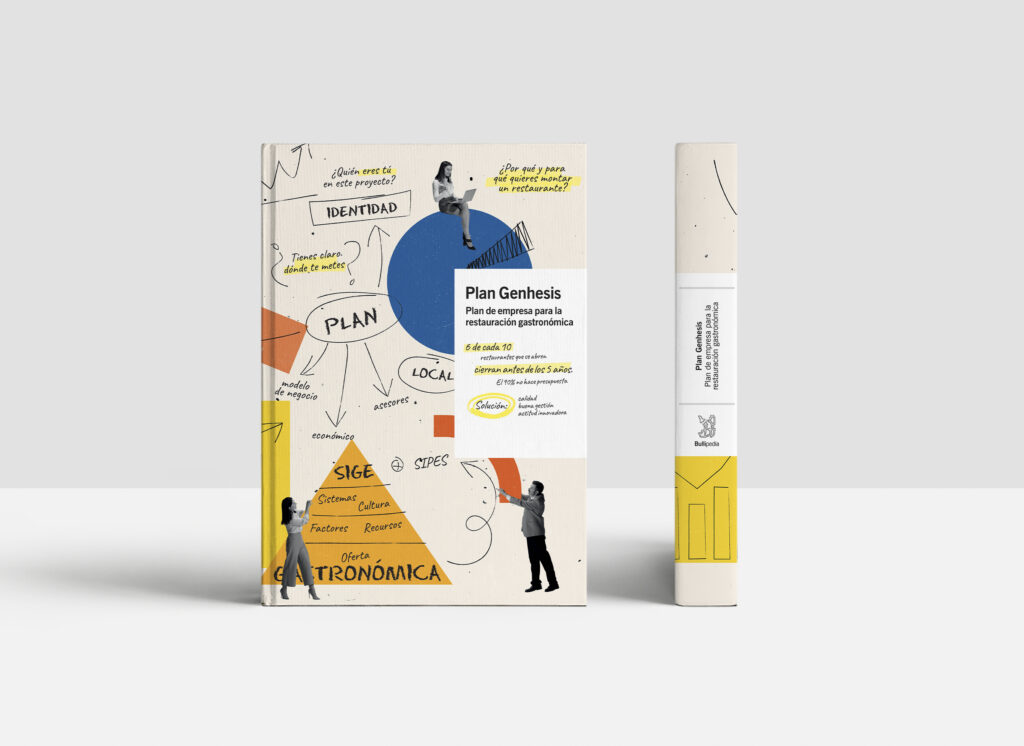
A new Bullipedia volume is published: Plan Genhesis, Business Plan for Gastronomic Restaurants, conceived as a comprehensive editorial project that integrates both physical and digital content.
The project was presented together with CaixaBank in two events held in Barcelona and Madrid.